

A root-treated tooth is meant to stay with you for years. But sometimes, even after proper care, infection can return.
At Dental Hub, Jamshedpur, we often meet people who are confused and worried when pain or swelling comes back in a tooth that was already treated. The good news is that in many cases, re-treatment can save the tooth again.
If you are exploring root canal treatment in Jamshedpur, understanding how re root canal treatment works and how successful it can be is important.
What Is Re Root Canal Treatment?
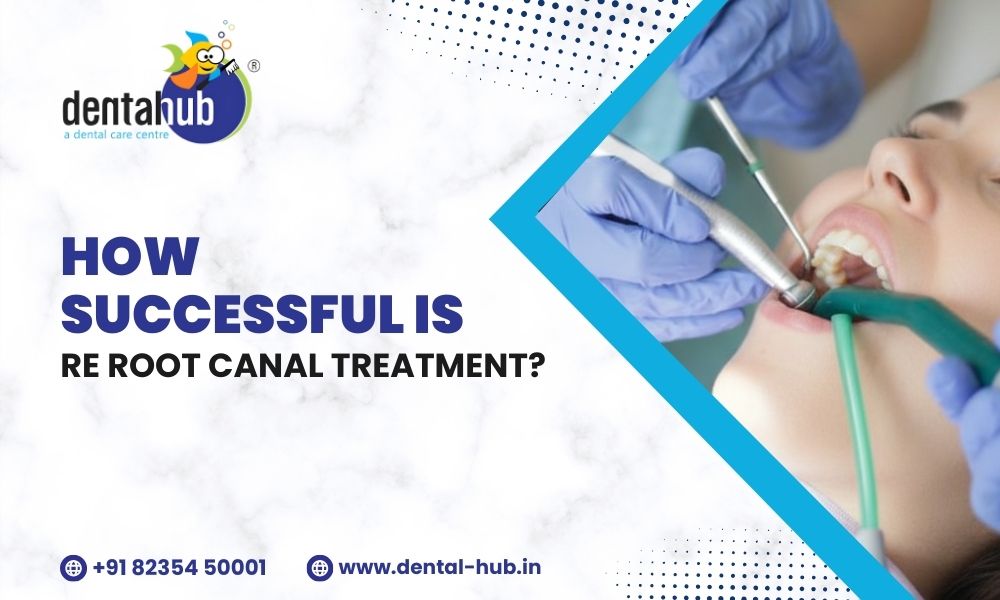
Re root canal treatment is a second procedure done on a tooth that has already undergone root canal therapy but has failed to heal properly or has become infected again.
In simple words, the dentist reopens the tooth, removes the previous filling material, cleans the canals again, disinfects them thoroughly, and seals them properly to prevent further infection.
It gives the tooth a second chance instead of removing it.
Why Does a Root Canal Fail?
A root canal treatment can fail months or even years after the original procedure. Sometimes there are symptoms like pain or swelling, and sometimes the problem is only seen on an X-ray.
Here are the common reasons:
Most Common Reasons
- Bacteria remaining inside the canals
Some canals may have been missed or not completely cleaned and filled. - New bacteria entering the tooth
This can happen due to:- A broken or loose filling
- A damaged crown
- New decay
- A crack or fracture in the root
Less Common Reasons
- Infection spreading from the root canal surrounding tissues
- Reaction to filling material that has extended beyond the root tip
- Development of a cyst at the end of the root (many of these still heal after proper retreatment)
In many cases, the problem is not the concept of the treatment, but incomplete cleaning, missed anatomy, or poor restoration after the procedure.
How Successful Is Re Root Canal Treatment?
The success of re root canal treatment depends on several factors. When done carefully and under proper isolation, the chances of success are high.
If:
- All canals are located
- Infection is fully removed
- Canals are shaped and sealed properly
- A strong permanent restoration (like a crown) is placed
Then the tooth can function well for many more years.
However, success rates may be slightly lower compared to a first-time root canal because:
- The tooth has already been treated once
- The infection may have spread further
- There may be structural damage
Still, in experienced hands, re-treatment is often a very effective option before considering extraction.
At clinics like Dental Hub, which offer root canal treatment in Jamshedpur, proper case selection and detailed evaluation play a major role in long-term success.
What Happens During Re Root Canal Treatment?
Many people think the second procedure is more painful or complicated. In reality, the process is systematic and controlled.
Step 1: Local Anaesthesia
The tooth area is completely numbed so you remain comfortable during the procedure.
Step 2: Rubber Dam Isolation
A rubber sheet is placed around the tooth. This is extremely important because:
- It prevents you from swallowing or inhaling small instruments
- It allows the use of strong disinfectants safely
- It stops bacteria from entering the tooth
Step 3: Removal of Old Filling Material
The previous root canal filling is removed carefully to access the canals.
Step 4: Cleaning and Disinfection
Small instruments (files) are used to clean and shape the canals again. The canals are repeatedly rinsed with disinfecting solutions to remove bacteria.
If required, an antibacterial dressing is placed inside the canals, and a temporary filling is given. This is why re root canal treatment time can sometimes extend to more than one visit.
Step 5: Final Filling and Sealing
Once the canals are clean, they are sealed properly. After that, a permanent restoration such as a crown may be recommended to prevent reinfection.
Re Root Canal Treatment Time – How Long Does It Take?
The time usually depends on:
- Complexity of the tooth
- Presence of infection
- Whether broken instruments are inside
- If extra canals need to be located
In many cases, the treatment is planned in two long appointments. Some simpler cases can be completed in a single visit, while more complicated cases may need additional sittings.
The time required is not a sign of difficulty. It often reflects thorough cleaning and careful work.
Is Re Root Canal Treatment Painful?
During the procedure, you should not feel pain because the tooth is properly numbed.
After the treatment, mild discomfort for 2–3 days is normal. This can usually be managed with prescribed medications.
Severe pain is uncommon but should be reported to your dentist.
When performed properly, root canal treatment is generally a comfortable procedure.
What Increases the Success Rate?
Certain factors significantly improve the outcome:
1. Treatment by an Experienced Dentist
Re-treatment requires precision. Finding all canals and removing previous materials can be technically demanding.
2. Complete Cleaning to the Root Tip
The canals must be cleaned, shaped, and filled up to the full length.
3. Good Quality Permanent Restoration
Back teeth with large tooth fillings often need crowns.
Pro Tip:
A crown after a root canal can increase the survival of the tooth several times compared to leaving it with just a filling.
4. Early Intervention
Treating the problem early, before infection spreads extensively, improves results.
Root Canal Treatment Cost – What Influences It?
Many people ask about cost of root canal treatment and how re-treatment differs from first-time treatment.
When discussing root canal treatment in Jamshedpur, it’s important to understand that the cost is influenced by clinical factors rather than just the procedure name.
The cost depends on:
- Tooth location (front vs back)
- Number of canals
- Complexity of infection
- Need for additional procedures
- Type of final restoration
At Dental Hub, Jamshedpur, each case is carefully evaluated before discussing the treatment plan so that you clearly understand what is involved.
Re-treatment may require more time and skill, which can influence the overall teeth root canal treatment cost. Instead of focusing only on cost, it is better to think about long-term value. Saving your natural tooth often avoids bigger procedures in the future and helps maintain normal chewing and alignment.
FAQs
1. Is re root canal treatment always successful?
It is successful in many cases, especially when infection is limited and canals can be cleaned properly. However, the success depends on the condition of the tooth, the extent of infection, and the quality of restoration. A detailed X-ray examination helps determine prognosis.
2. How do I know if my old root canal has failed?
Common signs include pain, swelling, or a gum boil. Sometimes there are no symptoms, and the problem is only seen on an X-ray. That is why periodic dental check-ups are important even if you feel fine.
3. Is extraction better than re-treatment?
If the tooth structure is strong and the infection is manageable, re-treatment is usually preferred. Extraction is considered only when the tooth cannot be saved, or the success chances are very low.
Giving Your Natural Tooth Another Fair Chance!
Re root canal treatment is not uncommon. Teeth can get reinfected for several reasons, but that does not mean they must be removed immediately.
With proper diagnosis, careful cleaning, and good restoration, many teeth function well for years after re-treatment.
If you are considering root canal treatment in Jamshedpur, choose a clinic that focuses on detailed evaluation, strict infection control, and strong long-term restoration.
At Dental Hub, we follow a systematic approach to retreatment so that every possible canal is located, cleaned, and sealed properly.
Preserving your natural tooth is always worth considering before opting for extraction.